Best Last Mile Delivery Software: 7 Platforms Worth Considering in 2026
We compare the best last mile delivery software for route optimisation, driver tracking, dispatch and proof of delivery, including Spoke, Onfleet and Routific.
The last mile has a habit of exposing every weakness in a delivery operation. Last mile delivery software is vital for so many businesses and industries, but its a software that isn’t often talked of, let along tested. Couriers, delivery drivers, truckers, there are so many applications. Lets take a look at the best last mile delivery software and why.
A route that looked sensible at 8am can be hopeless by midday. A mistyped address costs a driver twenty minutes. A customer who has no idea when their order will arrive calls the office. A failed delivery creates another journey tomorrow. Multiply those small problems across hundreds or thousands of stops and the cost becomes substantial.
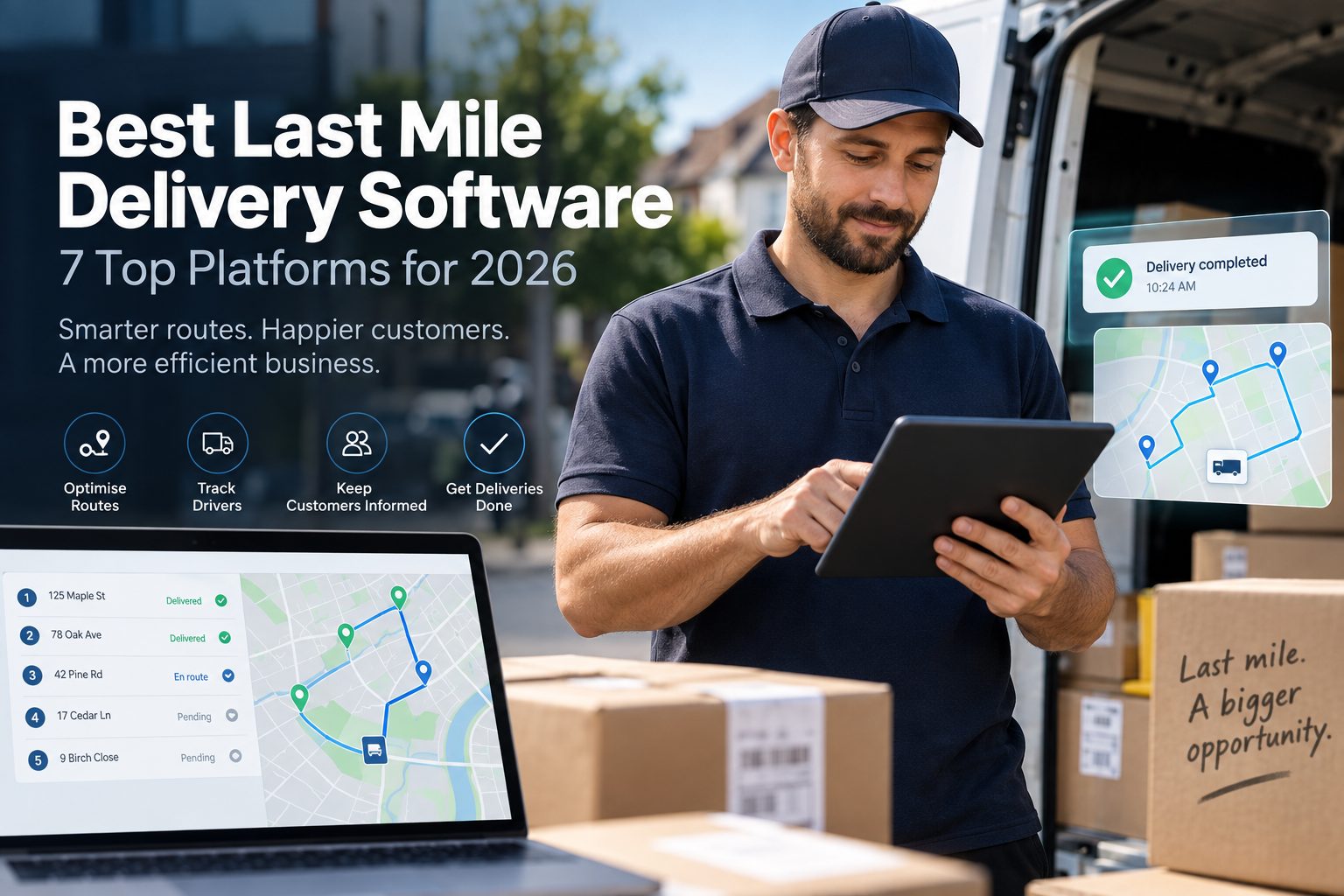
Good last mile delivery software is designed to bring some order to that chaos. The best platforms can optimise routes, coordinate drivers, provide live ETAs, keep customers informed and record proof of delivery without creating another complicated system for staff to wrestle with.
The difficulty is choosing one.
There are excellent specialist route planners, enormous enterprise logistics platforms and inexpensive delivery apps competing under the same broad label. A five-van local delivery business does not need the same system as a national retailer coordinating its own fleet alongside several third-party carriers.
For this guide, we looked at the products as actual businesses are likely to use them. We considered route planning, dispatch, the driver experience, live visibility, customer communication, proof of delivery, ease of implementation and overall value. We have also paid attention to where each platform stops making sense, because no responsible comparison should pretend that one piece of software is perfect for every delivery operation.
Our choice for the best last mile delivery software overall is Spoke Dispatch, particularly for small and medium-sized businesses that want sophisticated delivery management without burying drivers and dispatchers in complexity.
Best Last Mile Delivery Software At A Glance
Pricing and product features change frequently, so businesses should confirm current terms directly with the provider before purchasing.
1. Spoke Dispatch: Best Last Mile Delivery Software Overall
Best for: small and medium-sized businesses that need an excellent balance of routing, dispatching and driver usability.
There is an important distinction between software that looks impressive during a demonstration and software that still feels good on a wet Tuesday afternoon when drivers are behind schedule, customers are calling and three new deliveries have just appeared.
Spoke Dispatch is particularly convincing in the second situation.
Previously known as Circuit for Teams, Spoke Dispatch has been built around the practical realities of getting deliveries completed rather than treating routing as a mathematical exercise.
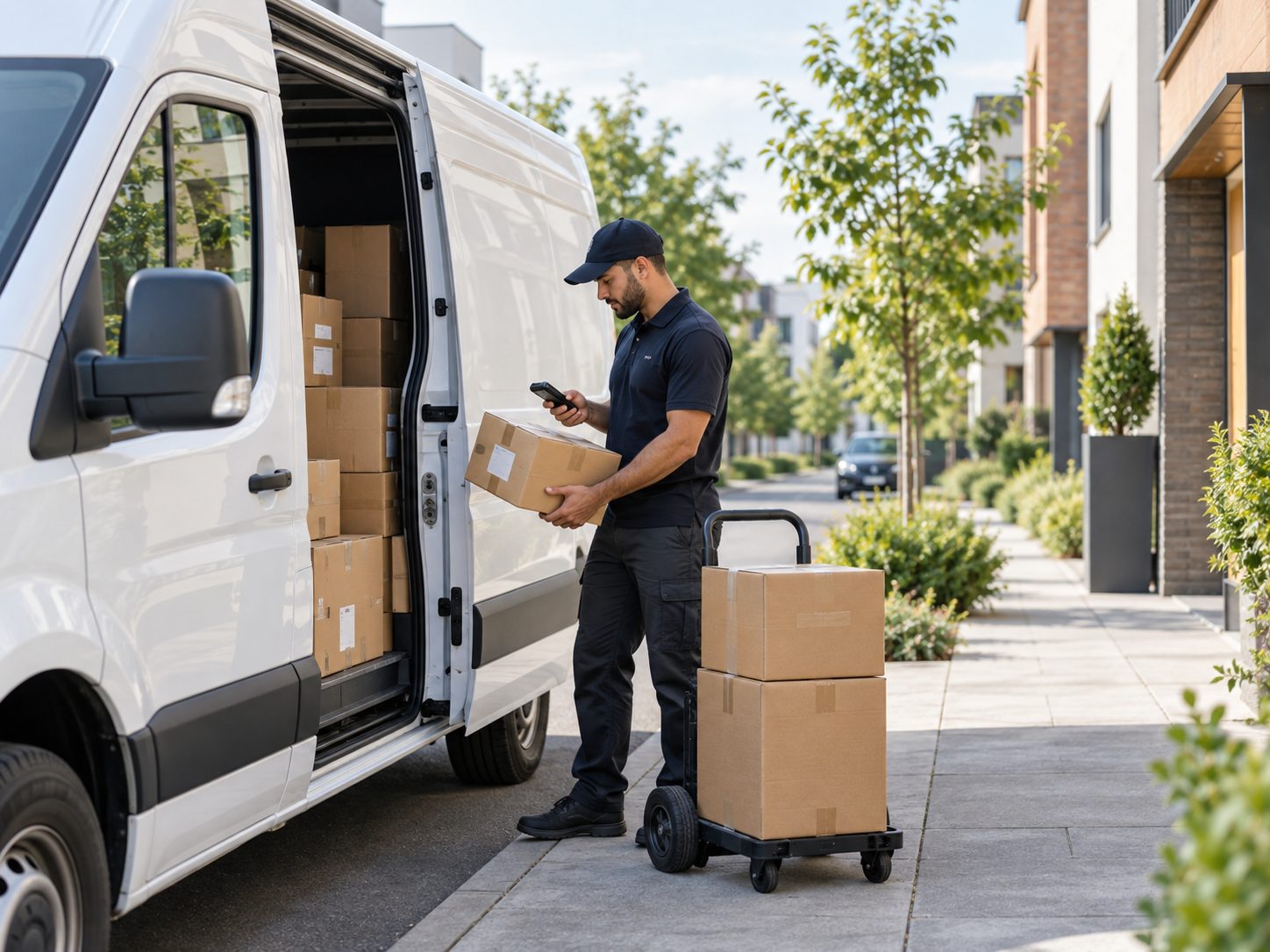
Routes can be created, optimised and sent to drivers, while dispatchers can monitor progress as it happens. Drivers receive the information they actually need at each stop, including recipient details and delivery instructions, and ETAs update as the day progresses. If circumstances change, the remaining route can be adjusted rather than leaving the driver to work things out manually.
That sounds straightforward. It should be. One of the recurring problems with logistics software is that sophisticated functionality gets confused with complexity. Every extra click matters when the person using the product is making dozens or hundreds of decisions every day.
Spoke's strongest quality is therefore not one spectacular feature. It is how the important features fit together.
Route optimisation sits alongside live tracking, customer communication and proof of delivery. Capterra currently lists features including route planning and optimisation, live driver tracking, dynamic ETAs, proof of delivery and customer notifications. It also gives Spoke Dispatch an overall user rating of 4.8 out of 5 from 105 reviews as of September 2026.
The driver side deserves particular attention. Spoke Dispatch's UK iOS application carries a 4.8/5 rating, while its Android application has more than 100,000 downloads and a 4.7-star rating at the time of writing. That matters more than it might appear. A theoretically brilliant dispatch system loses much of its value if drivers dislike it, require extensive training or constantly work around it.
Spoke also has serious mapping infrastructure behind it. The company uses Google Maps Platform services for mapping, navigation and address handling. Google reported that Spoke supported more than a billion deliveries worldwide during 2024 and has users across more than 180 countries. Google and Spoke have also reported average time savings of around an hour a day for drivers using the route-planning technology, although those figures should naturally be read as company-reported results rather than a guarantee for every fleet.
There is another less glamorous advantage: address quality. Anyone who has actually run deliveries knows that optimisation is useless if the destination itself is wrong. Spoke uses Google Maps Platform services to help validate, standardise and locate addresses before the problem reaches a driver. This is especially useful in the USA.
Where Spoke is particularly good
The compelling case for Spoke is the combination of an approachable dispatcher workflow and a driver product that people can get to grips with quickly. Businesses do not have to choose between a consumer-style route app that is too limited for management and heavyweight logistics software requiring a lengthy implementation.
For local couriers, ecommerce delivery businesses, food and beverage companies, retailers and other organisations running their own last-mile fleet, that middle ground is extremely valuable.
Pricing is competitive at the lower end too. Capterra currently lists Spoke plans starting from $125 per month, with higher tiers providing additional functionality and capacity. Businesses with rapidly increasing delivery volumes should nevertheless model the cost at their expected scale rather than judging software solely by its entry price.
Where another product may be better
Spoke would not be our automatic choice for a multinational retailer trying to orchestrate a complex network of owned fleets and third-party carriers. Bringg is built more directly around that enterprise problem.
Likewise, a company whose overriding priority is squeezing every possible mile from highly structured pre-planned routes should also trial Routific. Its optimisation technology is a major part of the product's proposition.
Those caveats do not weaken Spoke's position. They explain it. For the much larger group of businesses that need routing, dispatch, drivers and customers to work together without unnecessary operational friction, Spoke Dispatch is our best all-round choice.
2. Onfleet Best For Feature-Heavy Delivery Operations
Onfleet is one of the most mature names in last mile delivery software and deserves its place near the top of any serious comparison.
The platform goes considerably beyond basic route planning. Businesses can manage routes, track drivers, communicate with them, send customer updates, automate dispatching and collect detailed proof of delivery. Its proof-of-delivery toolkit supports photographs, signatures, barcode scanning and age or ID verification, making Onfleet particularly interesting to businesses operating in sectors where chain of custody or compliance matters.
Onfleet also offers API access and integrations for companies that want delivery operations connected more closely to ecommerce, CRM or internal ordering systems. Recent product development has continued to add route controls and more configurable delivery requirements.
The trade-off is price.
Onfleet's current Launch plan starts at $619 per month and includes 2,500 delivery or pickup tasks. Its Scale plan starts at $1,349 per month and adds functionality including barcode scanning, ID scanning, more advanced route optimisation and auto-dispatch.
For a substantial delivery operation, that can be perfectly reasonable. For a business with a handful of drivers, it is considerably harder to justify.
Our view: Onfleet is one of the strongest products here when depth of functionality matters more than keeping software expenditure low. Spoke is the better-balanced proposition for many smaller and mid-sized operators; Onfleet becomes increasingly attractive when operational complexity, compliance and integrations begin to justify its higher cost.
3. Routific Best For Route Optimisation-Focused Businesses
Routific has a very clear idea of what it wants to be good at: producing efficient, practical delivery routes.
That focus has paid off.
Its platform combines route optimisation with a visual dispatcher interface, driver applications, real-time tracking, customer notifications and proof of delivery. The software is particularly well suited to businesses that know most of their orders before vehicles leave the depot: food producers, wholesalers, florists, meal-preparation companies and other local delivery operations with planned daily rounds.
Routific places significant emphasis on avoiding what it calls "spaghetti routes", where drivers' territories cross over repeatedly despite the routes appearing mathematically efficient on paper. Its system considers traffic patterns and operational constraints and allows dispatchers to edit routes visually.
Pricing is interesting too. Businesses handling up to 100 orders per month can currently use Routific free, while 101 to 1,000 orders cost $150 per month. Beyond that, pricing moves to volume-based per-order charges that reduce as monthly volume increases. Drivers and dispatchers are unlimited under the current model.
There is one reason it sits below Spoke in our overall ranking: "best route optimiser" and "best last mile delivery software" are not quite the same question.
For a route-planning department managing carefully scheduled daily deliveries, Routific is extremely compelling. For organisations putting greater emphasis on the driver's day-to-day experience and straightforward dispatch, Spoke is arguably the more rounded choice.
Our view: Routific should absolutely be on the trial list of any business where route efficiency is the central purchasing criterion. It is one of the strongest alternatives to Spoke, rather than a token competitor added to make up the numbers.
4. OptimoRoute Best For Complex Scheduling
OptimoRoute becomes interesting when deliveries are not all alike.
Perhaps some customers need narrow time windows. Different vehicles have different capacities. Certain drivers have particular skills. Routes span several days. Vehicles need to return to a depot. Or delivery work sits alongside installation, inspection or field-service appointments.
This is where OptimoRoute earns its place.
Its Pro tier supports features including weekly planning, live tracking, live ETAs, analytics, proof of delivery, order tracking and customer feedback. The company currently advertises annual pricing from $35.10 per driver per month for Lite and $44.10 per driver per month for Pro, with custom plans available for more complex requirements.
That per-driver model can make OptimoRoute appealing to businesses with predictable fleet sizes.
The downside is that flexibility generally requires more configuration. A small courier company whose main requirement is simply to import today's jobs, generate sensible routes and get drivers moving may find Spoke quicker to live with. But businesses with detailed operational constraints should take OptimoRoute seriously.
Our view: An excellent specialist option for companies whose delivery planning resembles scheduling as much as traditional courier dispatch.
5. Bringg Best For Enterprise Delivery Orchestration
Bringg sits in a somewhat different category from most of this list.
It can optimise routes and manage deliveries, but its bigger proposition is orchestration: helping a large organisation decide how an order should be fulfilled across its own resources and external delivery providers.
Its platform supports route planning, resource management, carrier selection, real-time delivery monitoring, exception management and driver communication. It can also coordinate owned and third-party fleets from the same environment.
For a major retailer dealing with numerous fulfilment locations, service levels and carriers, those capabilities can be enormously useful.
For a ten-driver local delivery company, they may simply represent more system than is necessary.
This is why software rankings need context. Bringg can be the more capable platform in an absolute sense while still being the less sensible purchase for a typical small business.
Our view: Bringg is one of the strongest choices here for large and sophisticated delivery networks. Most SMEs should begin their search with Spoke, Routific or OptimoRoute before moving into enterprise territory.
6. Track-POD Best For Proof Of Delivery And Documentation
Some delivery companies need considerably more than a timestamp saying an order has arrived.
Wholesalers, food distributors, construction suppliers, healthcare-related operations and other B2B delivery businesses may need photographs, signatures, barcodes, delivery notes and records that can be retrieved months later when somebody disputes an order.
That is where Track-POD stands out.
The platform combines route planning and optimisation with real-time tracking, customer notifications, electronic proof of delivery, analytics and automated delivery documentation. It supports live map-based scheduling and provides an API alongside thousands of possible third-party integrations through Zapier.
Track-POD is not solely an ePOD product; it is capable of running a complete last-mile workflow. But proof and documentation are where its proposition is particularly easy to understand.
Its pricing structure deserves careful attention because the company offers alternatives based on drivers or delivery volumes, making the best-value configuration dependent on how your particular fleet operates.
Our view: Businesses that frequently deal with delivery disputes, signatures, scanned goods or formal delivery documentation should put Track-POD high on the shortlist.
7. Detrack Best Value For Smaller Fleets
Detrack is a useful reminder that capable last mile software does not necessarily have to cost hundreds of dollars a month.
Its Pro plan currently costs $29 per driver per month and includes live driver tracking, job updates, photographic and signature proof of delivery, customer notifications, tracking links, analytics, API access and integrations. Its $39-per-driver Advanced plan adds route optimisation, recurring orders, vehicle safety checks and more advanced analytics.
For a small delivery team, that is a lot of functionality for the money.
Detrack's model is also refreshingly straightforward: web users such as dispatchers and managers do not count towards the fee; billing is based primarily on drivers in the field.
It does not displace Spoke at the top because Spoke offers a more convincing all-round product experience for businesses that view last-mile operations as a major part of what they do. But a small fleet looking principally for tracking, customer updates, proof of delivery and competent route optimisation may find Detrack very difficult to beat on value.
Our view: Possibly the first product to investigate if the budget is tight but you have outgrown spreadsheets, WhatsApp messages and basic mapping applications. With that said, the couriers and businesses we’ve spoken to tend to outgrow the app pretty quickly.
What Should You Look For In Last Mile Delivery Software?
It is easy to compare software by counting features. It is also one of the quickest ways to buy the wrong product.
A platform with 150 features is not automatically superior to one with 50. What matters is whether the software removes work from your operation rather than relocating that work to another screen.
Start with routing, but do not stop there. Ask how quickly a dispatcher can turn an order list into workable routes and what happens when the plan changes. A demonstration based on a perfect set of addresses and zero interruptions tells you very little about the real world.
Then look at the driver application. Drivers may interact with the system hundreds of times a week. Navigation, notes, package information, route changes and proof of delivery need to be obvious without lengthy training.
Customer experience matters too. Accurate ETAs and tracking links reduce the number of "where is my order?" calls arriving at the office. Good proof-of-delivery tools can resolve disputes before they become expensive. Live tracking gives dispatchers the chance to solve a delay while it is happening instead of discovering it from an angry customer afterwards.
Finally, consider pricing in the way your business is actually expected to grow. Per-driver pricing is attractive when delivery volumes per vehicle are high and predictable. Per-stop pricing can work better when the number of drivers fluctuates. Enterprise contracts can make sense once integration and automation are saving enough administrative work to justify them.
If you are still building the delivery business itself rather than replacing existing software, our step-by-step guide to starting a cargo van business covers the broader operational side, from planning and licensing to vehicles and growth. We have also looked at cargo van business ideas and ways to start economically for those considering delivery and courier services as a new revenue stream.
Route Planning Software And Last Mile Delivery Software Are Not Quite The Same Thing
This distinction causes a surprising amount of confusion.
Route planning software answers a relatively narrow question: in what order should these stops be visited?
Last mile delivery software has to answer several more.
Who should make the delivery? Has the driver started it? Are they running late? Does the customer know they are coming? Was the package actually delivered? Can the business prove that? What happens when an address changes halfway through the day? Can the dispatcher see the whole operation without ringing six drivers individually?
Some excellent route-planning products now answer most of those questions too, which is why the categories overlap. But businesses should still buy based on the entire delivery process rather than the optimisation algorithm alone.
That is also central to our decision to put Spoke first. Routific may appeal more strongly when pure route optimisation is the priority. Bringg offers more enterprise orchestration. Onfleet has some advanced functionality Spoke does not attempt to match at its lower price points.
But for a typical growing delivery company that wants routing, dispatch, driver usability, customer communication and proof of delivery in one approachable product, Spoke offers an unusually convincing balance.
How Much Does Last Mile Delivery Software Cost?
There is no useful single average.
At the lower end, a small fleet can use products such as Detrack for tens of dollars per driver each month. Routific even provides a free tier for very low order volumes. Spoke's published third-party pricing currently begins at $125 per month, while Onfleet begins at $619 per month. Large enterprise platforms such as Bringg are generally sold around the requirements of the organisation rather than a simple public monthly price.
The more useful calculation is cost per successful delivery.
Software costing $500 each month but removing $2,000 of driver time, fuel consumption, failed deliveries and office administration is cheaper than a $100 platform nobody trusts enough to use properly.
When evaluating products, feed each supplier a representative week of real orders rather than a small artificial sample. Include awkward addresses, time windows, large routes and the types of exceptions that normally cause problems. The best demonstration is your own workload.
Frequently Asked Questions
What is the best last mile delivery software?
For the widest range of small and medium-sized delivery businesses, we rank Spoke Dispatch as the best last mile delivery software overall because it combines route optimisation, dispatch, driver usability, real-time tracking, ETAs, customer communication and proof of delivery in an approachable package.
The answer changes for specialist requirements. Routific is particularly strong for route optimisation, Onfleet suits more feature-intensive operations, Bringg is designed for complex enterprise delivery networks and Track-POD is particularly strong where electronic proof of delivery matters.
What is the best last mile delivery software for small businesses?
Spoke Dispatch is our leading recommendation for small businesses that carry out enough deliveries to need proper dispatch and route-management software.
Very small businesses with only a few drivers and a limited budget should also consider Detrack, while businesses making fewer than 100 deliveries a month may find Routific's current free tier sufficient.
Can last mile delivery software reduce delivery costs?
It can, but software itself does not magically make a fleet efficient.
Savings normally come from reducing mileage, driver time, planning administration, failed deliveries and unnecessary customer-service work. The amount saved depends heavily on how inefficient the existing process is. A company currently planning 200 stops manually has much more to gain than a business that already runs highly efficient routes.
Does last mile delivery software include proof of delivery?
Most serious platforms now do, although the level of detail varies considerably.
Photographs and signatures are common. More advanced platforms may also support barcodes, ID verification, geolocation, timestamps, notes and automatically generated delivery documentation.
Businesses carrying high-value, regulated or easily disputed goods should examine proof-of-delivery functionality in detail rather than assuming every platform handles it in the same way.
Should I choose software based on route optimisation alone?
Usually not.
Efficient routes are important, but drivers, dispatchers and customers all interact with the delivery process. A marginal improvement in theoretical route efficiency can easily be lost if dispatchers spend longer correcting routes or drivers struggle with the application.
The strongest last mile systems improve the complete operation.
Remember, if anything is ambiguous with the software on offer, simply go and ask one of the above businesses and they’ll clear it up for you. You could also do a free trial too.
Final Verdict: What Is The Best Last Mile Delivery Software In 2026?
There has never been a better selection of delivery technology available to businesses. There has probably never been a more confusing selection either.
Our top choice is Spoke Dispatch.
It succeeds because it gets the fundamentals right without making them feel laborious. Route planning is only one part of that. Dispatchers need visibility. Drivers need an application they can use without thinking about it. Customers need accurate information. Businesses need evidence that the delivery happened. Spoke connects those parts particularly well.
That does not make every other platform inferior.
Choose Onfleet when advanced functionality and compliance features justify a larger budget. Look closely at Routific when route optimisation is the centre of the decision. Consider OptimoRoute for complicated scheduling constraints. Evaluate Bringg if you are coordinating an enterprise delivery network. Put Track-POD on the shortlist when proof of delivery and documentation are critical. And look at Detrack when you need plenty of functionality at a comparatively low entry cost.
For the typical business that has moved beyond spreadsheets and basic route planners, however, Spoke occupies the sweet spot: sophisticated enough to make a meaningful operational difference, but simple enough that the people making the deliveries can actually enjoy using it.
That is why it is our pick for the best last mile delivery software in 2026. We’ve got a lot of great business advice, reviews and comparisons on business route.